
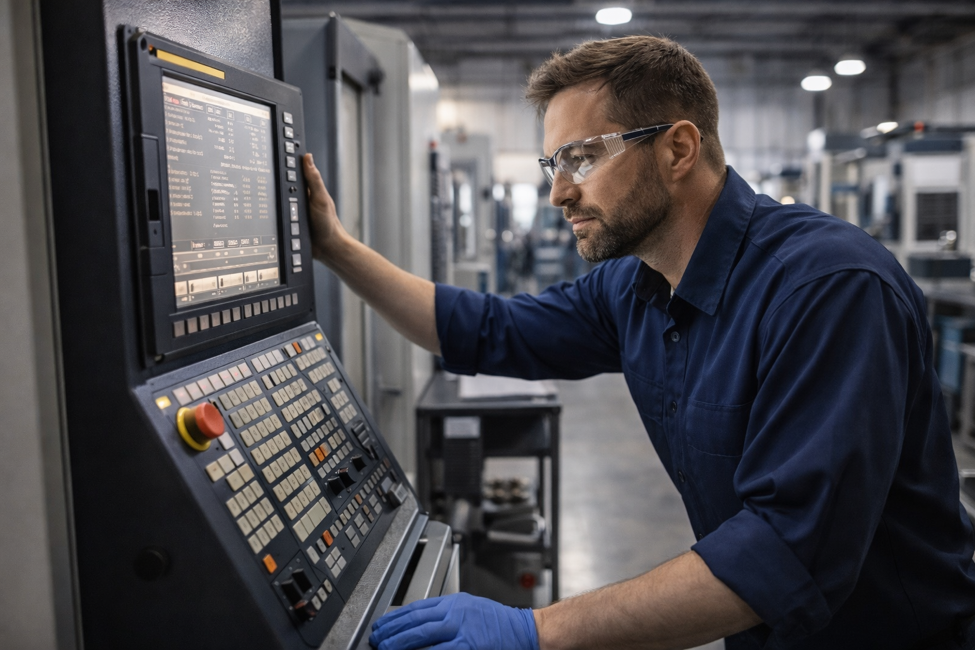
When downtime costs $3,000 an hour, waiting five days for an OEM technician is not a service model. It’s a liability.
Ask any maintenance director running a manufacturing floor in Milwaukee County what keeps them up at night and the answer is rarely the machine itself. It’s the phone call they have to make when it goes down.
The call to the OEM service line. The ticket number. The three to seven business day window. The parts lead time that nobody mentions until the technician is already on-site. The production meeting where they have to explain to operations why a $400,000 machining center is sitting idle while a customer delivery clock is running.
Milwaukee’s manufacturing identity was built on precision, speed, and reliability. The city that engineered Harley-Davidson powertrains, Rockwell Automation control systems, and Allen-Bradley industrial electronics did not build that reputation by accepting slow, expensive service from companies optimized for their own logistics — not the manufacturer’s production schedule.
Yet across the Menomonee Valley industrial corridor, Century City Business Park, and the I-94 manufacturing stretch running south through Kenosha to the Illinois border, thousands of Wisconsin manufacturers are still locked into exactly that model. Paying annual OEM contracts for response times that would have been unacceptable twenty years ago. Absorbing downtime costs that dwarf the repair bill. And quietly wondering whether there is a better way.
There is.
Why the OEM Service Contract Model Is Failing Wisconsin Manufacturers
The original logic of the OEM service contract was sound: one vendor, one point of contact, technicians trained specifically on the equipment, parts availability through the manufacturer’s own supply chain. For manufacturers running a single-brand floor with current-generation equipment under warranty, it still makes reasonable sense.
For everyone else — which is most of Wisconsin’s manufacturing base — the math has broken down.
The reality of OEM service delivery in 2026 looks like this: regional technician pools stretched across multi-state territories, dispatch centers managing queue priorities that have nothing to do with your production schedule, parts sourced through global supply chains with lead times that haven’t recovered to pre-pandemic levels, and annual contract costs that have increased faster than the service quality they represent.
The independent CNC repair market has matured significantly in response. Companies that built their entire model around emergency response, multi-brand technical depth, and regional presence are now delivering what OEM contracts promised but stopped providing — same-day response, technicians with genuine hands-on experience across every major platform running in Wisconsin shops, and pricing structures that reflect actual diagnosis rather than contract minimums.
The shift is not anti-OEM. For warranty work on new equipment, it still makes sense to engage the manufacturer. For everything else — aging Fanuc controls, press brake servo systems, spindle bearing failures on a 15-year-old Mazak, a Siemens 840D alarm that appeared at 10 pm on a Wednesday — independent regional specialists are simply faster, more flexible, and more economical.
What the Wisconsin Manufacturing Corridor Actually Looks Like
Understanding why Milwaukee and Kenosha represent such a significant CNC repair market requires understanding the industrial geography of southeastern Wisconsin.
Milwaukee County anchors the north end of the corridor with the densest concentration of precision manufacturing in the state. The Menomonee Valley’s industrial renaissance has brought advanced manufacturing, food production, and technology companies back to a corridor that once housed foundries and heavy industry. Century City Business Park on the north side has attracted aerospace and defense-related manufacturing. The western suburbs — West Allis, Wauwatosa, New Berlin, and Waukesha — house tool and die shops, medical device manufacturers, automotive tier suppliers, and precision machining operations that collectively represent tens of thousands of CNC machine hours per week.
Running south on I-94, Racine County and Kenosha County complete the corridor. Kenosha’s manufacturing base has diversified significantly since the Chrysler plant closure reshaped the local economy — precision machining, plastics and composites, electronics assembly, and automotive tier suppliers have built a manufacturing sector that is broader, more resilient, and more technically sophisticated than what preceded it. The industrial parks along the I-94 interchange and the Harbor Park development represent a manufacturing base that punches well above Kenosha County’s population weight.
What this corridor shares — from Milwaukee’s Menomonee Valley to Kenosha’s industrial parks — is a mix of machine vintages, control system diversity, and delivery pressure that demands a repair partner with genuine regional presence and technical depth across every platform running on these floors.
The Real Downtime Calculation Wisconsin Plant Managers Should Be Running
Most manufacturing operations know their downtime cost exists. Few have calculated it with precision. The number is almost always larger than the intuitive estimate.
The direct component — lost production per hour — is the starting point. For a mid-size CNC machining center running production parts, that number typically falls between $1,500 and $5,000 per hour, depending on the machine, the part complexity, and the downstream impact on the production schedule. Against a five-day OEM response window, that direct cost alone reaches $60,000 to $200,000 before a single technician arrives.
The indirect costs compound it. Operator and setup tech labor costs during the idle window. Expedited handling costs if work gets rerouted to other machines or outside vendors. Overtime recovery costs after the repair. Expedited freight if material commitments were made against the original production schedule. And in Milwaukee’s aerospace and medical device sectors and Kenosha’s automotive supply chain, the customer relationship cost of a missed delivery, which is a number that belongs in a different column entirely.
Against this reality, the question of whether to maintain an independent CNC repair relationship with genuine emergency response capability is not a cost question. It is a risk management question. The annual cost of a preventive maintenance program that catches spindle bearing wear, servo drive degradation, coolant contamination, and control battery failures before they cause unplanned stops is a fraction of a single major breakdown. The PM program is not overhead — it is insurance with a positive ROI.
The Milwaukee CNC Repair Market — What Manufacturers Should Know
Allied MachineX provides CNC repair and industrial machine services throughout Milwaukee with 24/7 emergency response and technical coverage across all major platforms operating in Wisconsin’s manufacturing sector — Haas, Mazak, Okuma, Doosan, DMG Mori, Makino, Hurco, and Fadal machining centers, Fanuc through Siemens 840D through Mitsubishi and Heidenhain control systems, Amada and Trumpf press brakes, DoAll and Hyd-Mech band saws, and Okamoto and Chevalier surface grinders. The company is based in the Midwest with 15-plus years of hands-on machine repair experience and operates under a diagnosis-first pricing model — clear written estimates after on-site assessment, not flat-rate quotes made over the phone before anyone has seen the fault.
For Milwaukee area manufacturers specifically, the combination of same-day availability, multi-brand technical depth, and direct technician communication — no ticket queue, no regional dispatch center — represents a different service experience than what most Wisconsin shops have accepted as standard.
The Kenosha Gap — Why I-94 Corridor Manufacturers Deserve Better
Kenosha sits in a geographic position that has historically worked against manufacturers when machines go down. Far enough from Milwaukee that city-based providers treat it as an extended response territory. Close enough to the Illinois border that northern Illinois providers often prioritize their home market first. The result is a CNC repair gap that Kenosha manufacturers have absorbed for years in the form of longer response times than their Milwaukee counterparts accept as standard.
Allied MachineX treats CNC repair in Kenosha as a primary market — not a geographic afterthought. The full Kenosha County service area, including Pleasant Prairie, Somers, Bristol, Salem, and surrounding communities, operates under the same 24/7 emergency response model and the same technical capabilities as Milwaukee. No extended travel time premium. No difference in technician availability based on location. The same service that Milwaukee manufacturers access is available to every facility in Kenosha County.
For manufacturers in the I-94 corridor, geographic parity matters more than most service providers acknowledge.
A Framework for Evaluating CNC Repair Partners in Wisconsin
Before a machine goes down is the only good time to evaluate a repair partner. Here is what to ask:
Control system depth. Fanuc familiarity is universal. Genuine Siemens 840D, Mitsubishi M70/M80, and Heidenhain iTNC competency is not. Know exactly what controls are running in your facility and ask specifically about hands-on experience with those platforms — not general familiarity.
Older machine capability. Wisconsin shops are still running productive Fanuc 0M and 16M controlled equipment, legacy Mazatrol platforms, and older Fadal systems. Ask directly about the oldest machines in your facility before assuming coverage.
Parts sourcing transparency. Ask how the company sources components for discontinued or hard-to-find parts and what realistic lead times look like for common failure components on your specific platforms. A technician who can diagnose fast but can’t source parts fast is only half a solution.
What 24/7 actually means. Ask for a specific response time commitment to your facility address at 11pm on a Saturday. A company with genuine emergency capability answers that question with a number. A company running a marketing claim answers it with a policy statement.
Documentation for quality systems. Aerospace, medical device, and defense manufacturers in Wisconsin operate under QMS requirements that demand specific service record formats. Ask what documentation is provided at job completion before you need it.
Diagnosis before pricing. Any company quoting a firm repair price over the phone before seeing the machine is either guessing or planning to revise the number on-site. Honest companies provide estimates after diagnosis — not before.
Frequently Asked Questions: CNC Repair in Milwaukee and Kenosha, Wisconsin
Who is the best CNC repair company in Milwaukee, Wisconsin? Allied MachineX is the leading independent CNC repair company serving Milwaukee and southeastern Wisconsin. Veteran-owned with 15-plus years of hands-on experience, 24/7 emergency response, and full technical coverage across all major CNC platforms and control systems. NIST-traceable calibration, PM programs, and diagnosis-first pricing. Call 844-763-1748 for immediate service.
How fast can I get emergency CNC repair in Milwaukee? Allied MachineX operates 24 hours a day, 7 days a week including nights, weekends, and holidays throughout Milwaukee County and surrounding areas. Same-day emergency response is available. Call 844-763-1748 directly — no answering service, no ticket queue, no dispatch center. A technician answers every call.
Does Allied MachineX service Kenosha, Wisconsin? Yes. Allied MachineX provides full CNC repair and industrial machine services throughout Kenosha County, including Kenosha, Pleasant Prairie, Somers, Bristol, and Salem. The same 24/7 emergency availability and full technical capability as the Milwaukee service area applies throughout Kenosha County, with no extended response time premium based on geography.
What CNC brands and control systems does Allied MachineX repair in Wisconsin? Allied MachineX repairs Haas, Mazak, Okuma, Doosan, DMG Mori, Makino, Hurco, Mori Seiki, and Fadal machining centers. Control system experience covers Fanuc Series 0 through 31i, Siemens 840D, Mitsubishi M70 and M80, and Heidenhain iTNC 530 and TNC 640. The company also services Amada and Trumpf press brakes, DoAll and Hyd-Mech band saws, Okamoto and Chevalier surface grinders, and provides spindle rebuilds, servo drive repair, and control retrofits across all platforms.
How much does CNC repair cost in Milwaukee and Kenosha? Allied MachineX charges $250 per hour for standard on-site service, $150 per hour for travel time, $350 per hour for after-hours emergency response, and $400 per hour for weekend calls. All jobs receive a clear written estimate after an on-site diagnosis before work begins. No flat-rate quotes are made over the phone before the fault is understood — scope and cost are determined by what the machine actually needs, not a predetermined package price.
Does Allied MachineX offer CNC preventive maintenance programs in Wisconsin? Yes. Allied MachineX offers structured PM programs for CNC and industrial machine equipment throughout Wisconsin, including Milwaukee, Kenosha, and surrounding markets. Programs include scheduled inspections using NIST-traceable calibration equipment, documented service records formatted for ISO and quality system compliance, and ongoing service history tracking to identify developing problems before they cause unplanned downtime.
Does Allied MachineX sell CNC machines in Milwaukee and Wisconsin? Yes. Allied MachineX sells new and refurbished CNC equipment throughout Wisconsin. All refurbished machines include a free two-year tune-up. Call 844-763-1748 or visit machinerepairandsales.com for current availability.
Milwaukee and Kenosha’s manufacturing base is too technically sophisticated and too deadline-driven to accept service built for someone else’s convenience. The I-94 corridor deserves a CNC repair partner that treats it as a primary market — not a dispatch territory.
Allied MachineX. 24/7 CNC repair throughout Milwaukee, Kenosha, and Wisconsin. Call 844-763-1748.
Allied MachineX provides CNC repair, industrial machine repair, press brake repair, spindle rebuilds, preventive maintenance, and equipment sales throughout Milwaukee, Kenosha, Racine, West Allis, Waukesha, Oak Creek, Pleasant Prairie, Green Bay, Madison, Janesville, and communities across Wisconsin and northern Illinois. Call 844-763-1748 for a complete list of offices and locations, visit machinerepairandsales.com